
The majority of the average individual’s life is spent at work, earning and providing for themselves and their families.
Inevitably, with that much time spent at the workplace, injuries while working are likely to occur at some point.
If you sustained an injury on the job in Missouri, you may need medical treatment and time off work to recover.
With few exceptions, employers are required to carry workers’ compensation insurance coverage to address these needs.
Unfortunately, some employers fail to provide the required insurance coverage.
Others may deny benefits to injured workers or terminate benefits prematurely, and you may need a workers’ compensation attorney to help you.
Missouri workers’ compensation claims often involve the industries that keep the state moving, including trucking along I-44 and I-70, construction in growing cities like Springfield, Joplin, Kansas City, and St. Louis, agricultural work in rural communities, and manufacturing jobs across the state.
These claims may move through the Missouri Division of Workers’ Compensation. They can involve Missouri-specific rules for medical treatment, wage benefits, disability ratings, occupational disease, uninsured employers, and the Second Injury Fund. When those rules intersect with a serious injury, even a small delay or mistake can affect whether an injured worker receives the benefits they need.
Some employers also retaliate against employees who file legitimate Missouri workers’ comp claims.
If you believe you aren’t getting the benefits you are entitled to, you need an experienced advocate to fight for you.
A Missouri workers’ compensation attorney at the Cottrell Law Office can help.
We assist injured workers just like you and fight to protect your rights and help you get the compensation you deserve for your injuries and lost wages.
Please don’t hesitate to contact an experienced workers’ compensation attorney at Cottrell Law Office for assistance.
What Is Workers’ Compensation?
In Missouri, if an employer has five or more employees, they are legally required to carry workers’ compensation insurance.
Workers’ compensation is a type of insurance that an employer provides to their employees to protect them after a workplace accident.
If you’ve suffered an accident while on the job that results in injury, you may be entitled to benefits. Workers’ compensation benefits include:
- Medical expenses
- Lost wages
- Temporary disability
- Permanent disability
If the work accident results in a death, workers’ compensation can pay out death benefits to the employee’s family.
Workers’ compensation insurance can provide much-needed financial help for employees and their families during a difficult time.
FEATURED REVIEW
“Wes Cottrell is a five star top rated law firm I have used Mr Cottrell for 10 years and he is settled a workman’s comp case for me getting me the maximum amount and recovery of over $200,000… Wes will never leave you in the dark always keep you informed of the status of your case. The knowledge and experience he has is the best there is the peace of mind that he gets the job done you can trust and that he is the best at what he does. Wesley is the best lawyer that I have ever had and I thank him 150% for having my interest at hand and protected.”
–Jay Peoples via Google

What Are the Four Types of Disability Benefits in Missouri That a Workers’ Compensation Attorney Helps Employees With?
Missouri workers’ compensation separates disability benefits based on whether the injury temporarily keeps the worker off the job, reduces earnings during recovery, or leaves lasting impairment. This distinction matters because a truck driver hurt on I-44, a construction worker injured in Springfield, a Joplin manufacturing worker with a hand injury, and a farm worker with a serious back injury may all qualify for different types of benefits under Missouri law.
The four disability types include:
- Temporary total disability—benefits for a worker who cannot return to work during recovery because the authorized doctor takes them completely off work;
- Temporary partial disability—benefits for a worker who returns to light duty, modified duty, or reduced hours but earns less than before the injury;
- Permanent partial disability—benefits for a worker who reaches maximum medical improvement but has lasting partial impairment, such as reduced use of a shoulder, knee, back, hand, or other body part; and
- Permanent total disability—benefits for a worker whose injury prevents them from returning to gainful employment, with weekly payments that may continue for life.
Maximum medical improvement often separates temporary benefits from permanent disability issues. Once the authorized doctor states that treatment has concluded or that the worker has reached maximum medical improvement, the claim may shift toward a permanent impairment settlement or a dispute over the correct disability rating. A workers’ comp lawyer can help review the medical opinion, job restrictions, and wage records before the insurer treats the disability classification as final.
What Missouri Workers’ Compensation Benefits Are Available?
Missouri workers’ compensation benefits may cover medical care, part of your lost wages, and disability payments if a work injury keeps you from earning your regular income. Benefit amounts usually depend on the worker’s average weekly wage, the authorized doctor’s work restrictions, and the type of disability involved.
Missouri workers’ compensation benefits may include:
- Temporary total disability—generally two-thirds of the worker’s average weekly wage when the authorized doctor says the worker cannot return to work during recovery;
- Temporary partial disability—generally two-thirds of the difference between the worker’s pre-injury earnings and what they can earn while working light duty or modified duty;
- Permanent partial disability—payment for a lasting partial impairment after the worker reaches maximum medical improvement; and
- Permanent total disability—weekly payments, potentially for life, when the worker cannot return to gainful employment because of the injury.
Missouri applies different maximum weekly rates depending on the benefit type. Temporary total disability and permanent total disability use a higher maximum rate than permanent partial disability. Missouri also does not pay compensation for the first three days of disability unless the worker remains unable to work for more than 14 days.
Workers’ compensation payments are generally tax-free. In fatal workplace injury cases, Missouri may also provide weekly survivor benefits and funeral expenses of up to $5,000. A skilled workman’s comp attorney like Wes Cottrell can review wage records, work restrictions, and medical ratings to determine whether the insurer calculated your benefits correctly.
Do You Qualify for Missouri Workers’ Compensation Benefits?
Although the laws vary between states, most employers are required by law to provide coverage for their employees.
If you sustained an injury on the job, you are likely entitled to have your medical treatment paid for under your employer’s workman’s compensation insurance. You may also be entitled to at least partial compensation for your lost wages.
Under the standard Missouri workers’ compensation rules, this coverage is considered to be “no-fault” insurance.
This means that even if the injury accident was your fault, you are still covered—with only a few exceptions. Outside of those exceptions, your employer cannot wrongfully deny your benefits.
Your employer may be able to deny your Missouri workers’ compensation benefits if you caused an on-the-job injury accident while you were:
- Drunk or high
- Breaking the law
- Engaged in unsafe behavior
- Not wearing required safety gear
- Violating company policy
- Violating safety rules or regulations
These and other exceptions may leave room for interpretation, potentially opening the door for your employer to deny your benefits wrongly.
A Missouri workers’ compensation attorney understands this complex area of the law. With an experienced attorney on your side, you can fight to get the benefits you deserve.
However, the specific workers’ compensation benefits to which you are entitled vary based on the laws of your state.
How Does Missouri’s Second Injury Fund Work?
Missouri’s Second Injury Fund may apply when a worker with a qualifying preexisting disability suffers a new compensable work injury, and the combined effect leaves the worker permanently and totally disabled. The fund exists because the last employer should generally pay for the disability caused by the last injury, not every limitation the worker already had before that accident.
Second Injury Fund issues may arise when:
- Preexisting disability. The worker had a medically documented disability before the new Missouri work injury.
- New compensable injury. The worker suffered a later injury that qualifies under Missouri workers’ compensation law.
- Combined disability. The old and new conditions together create permanent total disability.
- Separate liability. The employer remains responsible for the disability from the last injury alone, while the fund may address qualifying additional permanent total disability.
This can matter for Missouri workers in physically demanding jobs, including trucking, construction, manufacturing, agriculture, and warehouse work, where a prior back injury, knee injury, military-related disability, hearing loss, or other documented impairment may become much more serious after a new job accident. At Cottrell Law Office, we can help you determine whether a claim should involve only the employer and insurer or also the Second Injury Fund.
Related Reading: How to Calculate Your Workers’ Comp Benefits
What to Do After a Workplace Accident in Missouri?
What you do following an accident while on the job can significantly affect your claim. Keep these steps in mind to allow for a stronger claim and higher chances of approval for benefits.
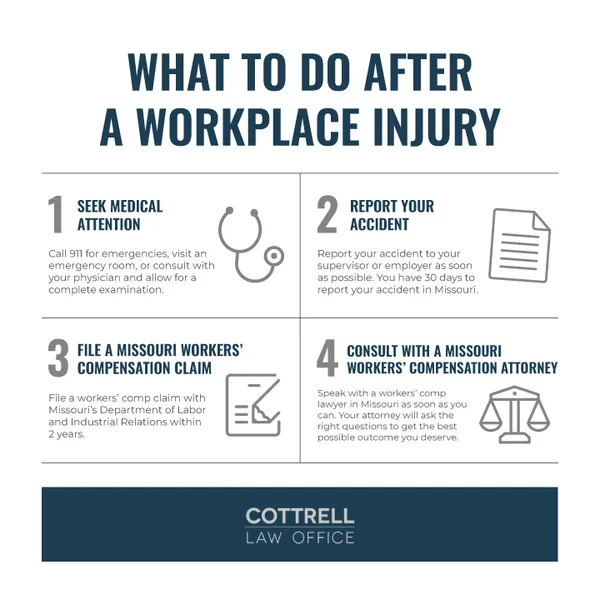
1. Seek Medical Attention
Your health and safety are a priority. If you suffer an accident at work and suffer an injury, seek medical help. Call 911 for emergencies, visit an emergency room, or consult with your physician.
Let your treating doctor know you were involved in a workplace accident and allow for a complete examination.
2. Report Your Accident
Report your work accident to your supervisor or employer as soon as possible. Under Missouri law, you have 30 days to report your accident. Failing to do so can result in the inability to seek workers’ compensation benefits.
3. File a Missouri Workers’ Compensation Claim
You will need to submit a claim for workers’ compensation with Missouri’s Department of Labor and Industrial Relations. In most cases, you will be allowed no more than two years to file your claim.
4. Consult with a Missouri Workers’ Compensation Attorney
Contact a workers’ comp lawyer in Missouri as soon as you can. Your attorney will ask the right questions, review the details of your claim, and help you get the benefits you deserve.
Workers’ Compensation Claims Differ by State
Workers’ compensation insurance eligibility and benefits differ from state to state. The differences can be significant.
The workers’ compensation attorneys at the Cottrell Law Office are extremely knowledgeable regarding the laws for Missouri, Arkansas, Kansas and Oklahoma.
Visit your state’s page to learn more about its specific laws and how they affect your job-related injury claim.
- Arkansas Workers’ Compensation Laws
- Kansas Workers’ Compensation Laws
- Oklahoma Workers’ Compensation Laws
- Missouri Workers’ Compensation Laws
In Missouri, employees are entitled to medical treatment and care, including all costs for authorized medical treatment, prescriptions, and medical devices.
There is no deductible and all costs are paid by the employer or its workers’ compensation insurance company.
In addition to medical benefits, a Missouri employee may be entitled to temporary total disability benefits and permanent partial or permanent total disability benefits.
What Is the Statute of Limitations for Workers’ Comp in Missouri?
Missouri workers generally must file a claim for compensation with the Missouri Division of Workers’ Compensation within two years after the date of injury, the date of death, or the last payment made on account of the injury or death. That deadline is different from simply reporting the injury to an employer.
Missouri gives injured workers more time in some cases, including:
- Employer report not filed. If the employer fails to file the required report of injury or death, the worker may have three years to file a claim.
- Last payment made. The filing period may run from the last workers’ compensation payment made on account of the injury or death.
- Second Injury Fund claim. A claim against Missouri’s Second Injury Fund generally must be filed within two years after the injury or within one year after filing a claim against the employer or insurer, whichever is later.
- Other forms do not stop the clock. Filing another form, report, receipt, or agreement does not pause the statute of limitations if the worker has not filed a formal compensation claim.
At Cottrell Law Office, we can help determine which filing deadline applies before the claim window closes.
Common Causes of Workplace Accidents
No two workplace accidents are the same, and the details surrounding the accident heavily depend on the industry and type of work.
However, some of the most common causes of workplace accidents include:
- Poor on-the-job training
- Inadequate safety gear
- Falls from heights
- Overexertion
- Falling objects
- Unsafe working conditions
- Defective or malfunctioning equipment
Accidents at work can happen from one second to the next, leaving you injured and facing many stresses. If you’ve been injured on the job, do not hesitate to contact a workers’ compensation lawyer in Missouri.
Injuries Resulting from Work Accidents
Like the cause of the accident, resulting injuries can also vary greatly.
Some of the most common types of injuries experienced after work accidents include:
- Cuts and lacerations,
- Burns,
- Fractured or broken bones,
- Loss of vision or hearing,
- Back injuries,
- Head and neck injuries,
- Traumatic brain injuries (TBIs),
- Spinal cord injuries and paralysis, and
- Injuries leading to amputation.
Depending on the injury, an employee can require extensive medical treatment and temporarily or permanently lose their ability to work and earn a living. In the most unfortunate circumstances, a work injury results in the death of the employee.
Don’t risk losing your right to receive full workers’ comp benefits—let Missouri workers’ comp attorneys help you.
How to File a Missouri Workers’ Compensation Claim
The deadlines and details for filing a workers’ compensation claim vary slightly from state to state; however, the process is essentially the same:
- The employee must report an injury accident to their employer prior to the prescribed deadline;
- The employer must then advise the injured employee how to obtain treatment within the allotted time frame;
- The employee must file a formal accident report with the insurance company; and
- The insurance company will award benefits based on a medical examination and the recommendations of the doctor.
Be very careful when completing the formal accident report for the insurance company. Your employer and the insurer can use anything you include in your report as a basis for denying your benefits.
Another area of concern is the medical examination. Both your employer and the insurance company want to minimize the benefits they must pay out.
Consequently, the doctor you are required to see might try to downplay the seriousness of your injury or deny necessary treatment.
Consult an experienced Missouri workers’ comp attorney to discuss these potential areas of concern. Your attorney can assist you in preparing your formal report, helping protect your legal right to obtain benefits.
Your attorney can also help you get the care you need and seek appropriate compensation for any temporary or permanent disability you might have suffered.
What Does the Missouri Division of Workers’ Compensation Do?
The Missouri Division of Workers’ Compensation oversees the state system for work injury claims. It does not act as the injured worker’s lawyer, but it provides the forum and procedures for resolving disputes over benefits, medical care, disability, settlements, and Second Injury Fund claims.
The Division may become involved when:
- A claim is filed. The injured worker files a formal claim for compensation when benefits are denied, delayed, underpaid, or disputed.
- Medical care is disputed. The employer or insurance company refuses treatment, questions whether care is work-related, or disagrees with the authorized doctor’s restrictions.
- Disability is contested. The parties disagree about temporary benefits, permanent disability, maximum medical improvement, or the correct disability rating.
- Settlement needs approval. The Division reviews workers’ compensation settlements before they become final.
- A hearing is needed. An administrative law judge may hear evidence and decide disputed issues.
Missouri claims do not usually begin in a city or county courthouse. Whether the injury happened at a Joplin factory, a Springfield construction site, a Kansas City warehouse, a St. Louis trucking terminal, or a rural farm, disputed workers’ compensation issues generally move through the Missouri Division of Workers’ Compensation.
Workers’ Compensation Benefits Are Important for Employees
The key purpose of workers compensation benefits is to compensate employees for injuries they suffer while at work or performing a job-related activity, without needing to prove who was at fault for the injury.
In exchange for these benefits, the employees who are covered under the law agree not to file a lawsuit against their employer relating to those injuries.
As useful as these benefits can be, if making a workers’ compensation claim lead to retaliation by your employer, the benefits may not seem worth the risk.
Your workers’ compensation lawyer in Missouri can help you if that happens.
Which Missouri Industries and Cities See the Most Workers’ Comp Claims?
Missouri workers’ compensation claims often come from the industries that shape daily work across the state. A claim from a Joplin manufacturing plant may look different from a trucking injury near St. Louis, a construction accident in Springfield, a warehouse injury in Kansas City, or an agricultural injury in a rural county. But each claim still depends on the same core question: whether the injury arose out of and in the course of employment.
Missouri workers often suffer job-related injuries in industries such as:
- Trucking—crashes, loading injuries, dock accidents, repetitive back strain, and injuries from long-haul routes on I-44, I-70, I-55, and I-35;
- Agriculture—tractor accidents, livestock injuries, grain-bin hazards, heat exposure, repetitive lifting, and injuries involving farm machinery;
- Construction—falls, ladder accidents, electrical injuries, equipment accidents, trench injuries, and struck-by injuries on residential, commercial, and road projects; and
- Manufacturing—machine injuries, burns, hand injuries, repetitive-use injuries, hearing loss, and chemical exposure in plants, warehouses, and production facilities.
Location can also affect the practical side of a claim. Medical providers, employers, witnesses, jobsite records, and hearing logistics may differ depending on whether the injury happened in Joplin, Springfield, Kansas City, St. Louis, Columbia, Jefferson City, or a smaller Missouri community. Cottrell Law Office understands that every workplace injury is unique, from the jobsite to the medical record. We approach each claim individually and build a strategy around every individual worker’s actual needs.
What Happens If My Missouri Employer Does Not Have Workers’ Compensation Insurance?
When a required employer lacks coverage, the injured worker should not assume they don’t have options.
An uninsured-employer situation may involve:
- A workers’ compensation claim. The worker may still file a claim through the Missouri Division of Workers’ Compensation.
- Employer liability. The employer may remain responsible for medical benefits, wage benefits, disability benefits, and other amounts owed under Missouri workers’ compensation law.
- Legal penalties. Missouri can penalize employers that fail to carry required workers’ compensation insurance.
- Lawsuit issues. Lack of insurance may affect whether the injured worker has claims or remedies outside the ordinary workers’ compensation process.
This issue can arise among smaller contractors, subcontractors, farms, trucking companies, restaurants, repair shops, and local businesses that misjudge their coverage obligations or misclassify workers. At Cottrell Law Office, skilled workman’s comp attorney Wes Cottrell can investigate whether the employer had valid coverage, whether another company may share responsibility, and how to pursue benefits when the insurer’s safety net is missing.
Understanding the Independent Medical Examination (IME) Process
One of the most pivotal and often misunderstood parts of the Missouri workers’ compensation process is the Independent Medical Examination (IME). While it may sound neutral, your employer’s insurance company often requests the IME to challenge or limit your benefits.
The insurance company chooses the doctor and pays for the exam. That doctor’s assessment can determine whether your injury is deemed serious, work-related, or even real.
If the IME physician downplays your condition or claims your injury preexisted your job, your benefits could be reduced or denied.
You do not have to go into an IME unprepared. A skilled Missouri workers’ compensation attorney can help you understand what to expect, how to communicate your symptoms clearly and truthfully, and what red flags to watch for during the appointment.
If the IME results are unfair, your attorney can also obtain a second opinion from a neutral or treating physician and challenge the report.
How Pre-Existing Conditions Impact Your Workers’ Comp Case
One of the most common reasons a Missouri workers’ comp claim gets contested is the presence of a pre-existing condition. If you’ve previously injured your back, neck, knees, or another body part, even years ago, the insurance company may argue that your current condition isn’t their responsibility.
However, Missouri law recognizes that work accidents can aggravate or accelerate existing injuries. If your job worsens your condition, you may still qualify for benefits. The key is providing medical evidence that links the current injury to your work activity.
A skilled attorney can gather supportive opinions from your treating doctors and use prior medical records to prove the connection. Don’t let a pre-existing condition scare you away from seeking help.
Common Tactics Insurance Companies Use to Deny Claims
Even when you do everything right, insurance companies use tactics to delay, diminish, or deny your workers’ compensation benefits. These tactics are not always obvious. Some common strategies include:
- Claiming your injury occurred outside of work or was a pre-existing condition;
- Delaying treatment authorizations to pressure you into returning to work too soon;
- Cherry-picking favorable parts of your medical records while ignoring serious diagnoses;
- Hiring private investigators to watch you for signs of exaggerating your injury; and
- Offering quick, lowball settlements before the true cost of your injury is known.
These strategies can be subtle and disorienting. Many injured workers don’t know their rights or how to push back. That’s why consulting an attorney early in the process can be so powerful. With experienced legal counsel, you’ll be better equipped to recognize these tactics and respond appropriately.
What Does Missouri Workers’ Compensation Retaliation Mean?
The legal definition of retaliation (in the employment context) is basically taking an “adverse employment action” against an employee for “engaging in legally protected activity.”
Filing a claim for a work-related injury, under the Worker’s Compensation Act, is considered a legally protected activity because employees are legally authorized to file such claims.
Therefore, the employee is protected from any retaliation or negative consequences from his or her employer, simply because they filed a Missouri workers’ compensation claim.
Retaliation for Making a Workers’ Compensation Claim in Missouri Is Prohibited
Although the right to workers’ compensation benefits is established by law, many employees are afraid to file a claim because they fear losing their job.
However, Missouri law prohibits an employer from discriminating or firing an employee for filing a workers’ comp claim.
However, an employer may “lawfully discipline or terminate pending workers’ comp claimants [or] those who have former workers’ comp claims as long as it is not retaliatory and as long as it is based on misconduct that is unrelated to the workers’ compensation claim.”
So, it may be difficult to prove that the discipline or termination is actually related to the workers’ compensation claim.
If you are treated differently at work following your submission of a workers’ compensation claim, seek the counsel of the skilled MO worker’s compensation attorneys at the Cottrell Law Office.
Retaliation takes many forms and we can explain your rights and assist you to pursue all available remedies.

We’ll take care of everything else.
Submit the short form below to schedule a consultation.
How Widespread is Workers’ Compensation Retaliation?
Some reports have indicated that retaliation by employers has become a serious problem. According to the Bureau of Labor Statistics (BLS), nonfatal workplace injuries and illnesses decreased by 8.4% from 2022 to 2023, reaching their lowest level since 2003.
This significant decrease has been attributed to various factors, including safer work conditions.
Yet, some experts believe a major factor in the decrease of reported injuries is the increase in retaliation for making workers’ compensation claims.
It is believed that employers are taking more aggressive steps to discourage employees from reporting their injuries.
Indeed, some statistics show that, although workers’ compensation claims have dropped, the number of workers’ compensation retaliation claims has doubled.
A Missouri Workers’ Compensation Lawyer Explains Why Some Employers Retaliate
The bad news is, many employers respond to claims of workplace injuries by blaming the employee for the injury and challenging the claim.
Some employers even find ways to punish employees for making a workers’ compensation claim.
Consequently, many employees are fearful of bringing workers’ compensation claims because of the potential negative consequences.
This type of conduct by employers goes against the purpose and goals of the workers’ compensation system, which is to quickly provide relief to employees who are injured on the job.
Your workers’ compensation lawyer can assist you.
OSHA’s Opinions About the Causes of Workplace Injuries
The U.S. Occupational Safety and Health Administration (OSHA) has reported that a substantial number of workplace injuries have gone unreported in recent years.
OSHA’s investigations have found that most workplace injuries still arise out of unsafe working conditions, rather than employee negligence.
For this reason, if an employee reports an injury, a subsequent investigation may lead to the company’s liability for fines and other violations.
When Should You Hire a Missouri Workers’ Comp Lawyer?
While it is certainly a good idea to consult a workers’ compensation lawyer when you are facing retaliation issues, this is not the only situation where seeking professional advice would be wise.
When there are any complicated issues in your workers’ comp case, the wisest decision is to consult with a skilled workers’ compensation lawyer in Missouri.
For instance, if your employer denies your claim or you do not receive your benefits, as you should, then an attorney should get involved.
Many employees who are injured at work do not appeal the denial of their claim.
Consulting a workers’ compensation lawyer provides you with the best chance of receiving a fair settlement for your injuries. Reach out to our firm to get started on your case.
A Workers’ Comp Lawyer Answers Your Missouri Workers’ Compensation FAQs
Can I Get Workers’ Comp for an Occupational Disease in Missouri?
Yes. Missouri workers’ compensation may cover an occupational disease when workplace exposure causes the condition. These claims may involve hearing loss from manufacturing work, respiratory illness from dust or fumes, chemical exposure in agricultural or industrial jobs, or other work-related diseases that develop over time.
What Missouri City or County Do I File My Claim In?
You generally file a Missouri workers’ compensation claim with the Missouri Division of Workers’ Compensation, not a city or county courthouse. The injury may occur in Joplin, Springfield, Kansas City, St. Louis, Columbia, or a rural Missouri county, but disputed claims are handled through the state workers’ compensation system.
Can I Choose My Own Doctor for a Missouri Workers’ Comp Claim?
In most Missouri workers’ compensation claims, the employer or insurance company has the right to choose the treating doctor. If you seek treatment from your own doctor without approval, the insurer may dispute payment, so it is important to understand the authorized treatment process before scheduling non-emergency care.
Can My Employer Retaliate Against Me for Filing a Missouri Workers’ Comp Claim?
Missouri law prohibits employers from firing or discriminating against an employee for exercising workers’ compensation rights. Retaliation may involve termination, reduced hours, demotion, discipline, threats, or other adverse treatment after an injury report or claim.
Can I See My Own Doctor for Treatment After a Workplace Injury?
In Missouri, your employer (or their insurer) has the right to choose the treating physician for workers’ compensation cases. If you see a doctor without their approval, they may not be required to cover the cost. However, if you are dissatisfied with the care provided, your attorney can request a change of physician or obtain a second medical opinion.
What Happens If My Injury Keeps Me From Ever Working Again?
If your work injury leaves you permanently disabled and unable to return to any form of employment, you may qualify for permanent total disability (PTD) benefits. These benefits provide ongoing payments and may also open the door to additional compensation through the Second Injury Fund or Social Security Disability Insurance (SSDI).
Can I Settle My Workers’ Comp Case?
Yes. Many Missouri workers’ compensation cases are resolved through a lump sum settlement. This allows you to receive a one-time payment in exchange for giving up your right to future benefits. However, you should never accept a settlement without consulting a workers’ compensation attorney—once you sign, you cannot reopen your case if complications arise later.
How Long Will It Take to Receive My Benefits?
The timeline varies. Medical treatment should begin soon after the injury is reported. Wage replacement benefits may take a few weeks to process. If your claim is disputed, the process could take months, especially if it goes to a hearing. An attorney can help speed things up by ensuring your paperwork is complete, medical documentation is submitted promptly, and all deadlines are met.
Is Stress or Mental Health Covered Under Workers’ Comp?
In limited circumstances, yes. Missouri workers’ compensation law recognizes certain mental health conditions—such as PTSD or anxiety—as compensable if they stem directly from work-related trauma or events. These cases are more difficult to prove and require extensive medical evidence and expert support, but they are possible with strong documentation.
Talk to an Experienced Missouri Workman’s Comp Attorney at Cottrell Law Office
A Missouri workplace injury can affect your health, your paycheck, and your ability to keep up with ordinary expenses while you recover. When medical treatment gets delayed, disability checks stop, or the insurance company disputes your claim, you need someone who understands how Missouri workers’ compensation claims actually move through the system.
At Cottrell Law Office, Wesley Cottrell brings more than 40 years of experience to workers’ compensation and personal injury cases. From the firm’s Joplin, Missouri, office, we help injured workers understand their rights, respond to denied or delayed benefits, and pursue the compensation available under Missouri law.
To schedule a free consultation, contact us online today for assistance.